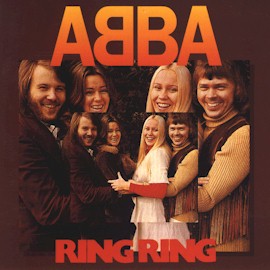

Ring Ring
Polydor remastered CD 1997
2nd paragraph, 1st column: "Only later in 1973, when 'Ring Ring' as a single had been a huge success - it eventually topped the charts in Australia, Belgium, Denmark, Finland, Holland, Norway, South Africa and Sweden - did it occur to anyone to simplify that ludicrously clumsy name." Wrong and wrong. 'Ring Ring' topped the charts only in Sweden (where in fact, the Swedish version topped the chart and the English version peaked at number 2) and Belgium. In some territories, it wasn't even a hit until after ABBA won the Eurovision Song Contest in 1974 (for example, in Australia it was finally a hit in 1976, peaking at number 7). Stig Anderson realised from the start the four individual names were unsuitable as a group name - he stated his disapproval even before the release of the 'People Need Love' single in 1972.
2nd paragraph, 2nd column: "Anderson's idea was for the quartet to represent Sweden in the 1973 Eurovision Song Contest." Wrong. Benny, Björn and Stig were invited to participate as songwriters, as they had for several years previously, but this time decided to perform themselves, rather than have another singer perform their song.
continuing: "… Benny & Björn could choreograph the way in which they and Agnetha & Frida performed it." Curious concept. Generally Björn and Benny concentrated on the music and production, and left such matters as choreography and performance to Agnetha and Frida (though of course they had some input).
2nd paragraph, 3rd column: "… they had recorded versions of 'Ring Ring' in German, Spanish and English, as well as in Swedish, and these versions were released during 1973." Wrong. The Spanish version was not released until 1993, when it appeared on the CD ABBA Más Oro.
continuing: "Another notable historic track on the album was 'People Need Love', credited to Björn & Benny with Svenska Flicka, which as almost a US hit in 1972…" A slightly misleading statement, as the single was released under this belling in the USA only. Describing the song as "almost a bit" is a bit of an exaggeration, as it had not quite reached the top 100 when distribution problems caused sales to stall.
In general, the notes concentrate on the Eurovision Song Contest, and when the topic of the album itself is finally mentioned, the only songs mentioned are those that had been previously released in the UK, either as single B-sides or were included on the 1975/76 Greatest Hits album.