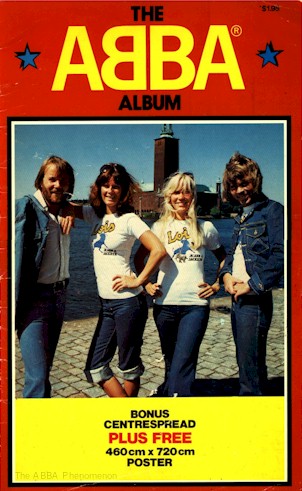
THE ABBA ALBUM
by Peter Charley. Horowitz Publications January (?) 1977
Since Abba last came to Australia, their popularity here has exploded into one of the most remarkable music followings in history.
Their last Australian visit, timed to coincide with their swelling popularity overseas, drew a very strong reaction within the country. During their stay, the band took part in a bout of intense interviews worth the music and news media.
Instead of performing here live, they concentrated on the production of a television special which, when finally screened on Bandstand, became one of the most sought after clips in the country.
Designed as an effective means of displaying Abba's talent to as many people as possible, this show attracted the phenomenal rating of more than 54 percent of available viewing audience in Sydney during a prime weekend time slot.
For Abba, this was a victory in national promotion - a typically clever step which, in the midst of a dawning Australian following, helped boost their popularity to record levels.
This film, and the interest it generated, made a deep impression throughout Australia.
Shortly after the national screening of the band, 'Fernando', which had just been released, rocketed to the top of the charts. So successful was this song, in fact, that by mid-April it was reaching gold record status, through national sales, every week.
Like so many Abba songs, it remained in number one position for months, totaling, by the end of the year, sales equaling 25 gold discs.
The outstanding popularity of this single, surpassing 'Hey Jude' by The Beatles, as the longest standing hit in Australia, led Abba, in September, to sign a $1 million advertising contract with the National electronics company. This deal, covering a series of five 60-second television commercials, used the score of 'Fernando' as the theme tune for the words, "There is so much more to National..." - again breaking new ground as the first advertisements ever made by the Swedish band.
The commercials were put together when, after negotiating for several weeks with the band, National sent an Australian film and recording crew to Sweden to catch the group in their normal surroundings.
Once again, this was a "first" for Australia, as the crew were allowed to travel to Abba's private island in the Stockholm archipelago and film the band within their historic homes.
Until then, cameramen, soundmen and journalists were forbidden access to the private quarters of the band.
Abba's decision to allow the Australian crew into their homes caused a sensation in Australia. Fans, thirsty for personal information on the singers, grasped with enthusiasm a series of exclusive reports sent by members of the National team, describing the gracious, behind-the-scenes life of the band.
By April last year, Abba had become firmly established as the most popular foreign line-up ever to reach Australia, with their radio ratings zooming to four singles in the top five.
Of course, Abba were delighted with these figures. In a matter of months, Australia had emerged as one of their most fanatical countries, a position it still holds today.
But with this success, there came an enormous demand from fans for new material from the group. Merchandise relating to the band became extremely popular within the country, and before long an overwhelming range of Abba goods began to appear on the market. Bangles, candles, t-shirts, posters and pendants began to spread throughout the country as fans rushed to gather tokens of their love for the Swedish group.
At this stage, however, the production of such goods was not properly controlled - a fast which soon became a great worry to Anna [sic], Bjorn [sic], Benny and Frida. So, concerned that their image was being harmed, the band ordered that the production and sale of all Abba goods in Australia be carefully monitored.
In May, Stig Anderson - Abba's manager - appointed Reg Grundy Productions as the sole advertising and merchandising agents for his band in Australia.
In a bid to stamp out "pirate" goods, he ruled that no people wishing to market Abba merchandise could do so unless their product was approved by the Grundy organisation.
By the end of last year, Grundy Productions had issued 20 merchandise licences - boosting the market with a huge range of products including Abba socks, cushions, bubble gum, medallions and jigsaws.
As well as providing fans with a variety of new Abba tokens, the production of this merchandise created employment for thousands of people in Australia - giving the economy a very hefty boost.
Thus, the power of Abba had made its mark on the lives of people from countless different professions.
The pressing of Abba's latest album, Arrival, for example, became such a demanding task that RCA, Abba's recording company in Australia, was forced to turn to six other record companies in Australia and two in New Zealand to help press copies of the record.
The demand for this album was so great that RCA had to hire extra staff to man a massive warehouse, rented specially to house the record.
By the time it was due for release, Arrival had sold more than 600,000 copies - just through advanced orders,. This figure was boosted to more than one million in a matter of weeks after its release.
Stig Anderson, hearing of the mammoth advanced sales of Arrival, flew to Australia to help launch the album.
His charm and excellent manners took the country by surprise as he thanked all fans for their part in Abba's success.
Often called "the fifth Abba", Stig plays a major role in the composition and production of the bands music.
A musician himself, he has been writing songs since he was 16 - many of which have been recorded by notable European artists.
Before forming his internationally famous music publishing company, Sweden Music, Stig's songs had become hits throughout Scandinavia, Sweden and Holland.
Stig first met Abba shortly after opening Sweden music on the mid-1960s. With Success breeding success, his publishing company began top represent catalogues in Scandinavia for more and more foreign publishers. By the late 1960s, he had acquired representation for MCA Music, Don Kirshner and Sugar Music. Today, Sweden Music also represents the catalogues of Rondor Music, Lowery Music, ABC/Dunhill music, 20th Century Music, RAK music, MAM Music, ATV Music and Big 3. Stig is considered now to receive one of the highest incomes in the Swedish performing rights society.
During the establishment of his empire, Stig's relationship with Abba blossomed, and the popularity of his band quickly spread to the world.
Now, regarding Abba more as a family than a band, he carefully supervises their moves throughout the world and gently eases them through their problems.
"We are very close and we all love each other", he said during his last visit to Sydney.
"I am delighted, we are al delighted, at the popularity of Abba.
"Everywhere we go we are met by a huge group of fans, all of whom seem to be very, very nice people."
With Abba's record sales exceeding those of the Beatles, many people have compared the Swedish band with the Lennon and McCartney line-up.
Some argue that Abba is better, but to Stig Anderson , there is no way of telling.
"Many people have compared the Abba family with the Beatles, and many people have asked me who I think is better.
"I can only say that I don't know - we are two completely different bands, it is very hard to compare us.
"The Beatles were very popular and so are we - I don't know what it is that makes Abba so well liked - you tell me.
"When We write music, we do it because we love music - money doesn't matter so much to us - we write because we like it, and if other people like our writing was are very happy."
It is an attitude which has helped make Abba stand out in the world of rock 'n' roll.
They are known as an honest and humble band, with their fame having no effect on their quest, home-loving lives.
This warm, loving image has, in many ways, contributed to their success and won the respect of millions of people throughout the world.
Even in some of the most remote countries, people consider Abba in this light.
In Africa, for example, the band recently signed a contract allowing the sale of their records in Tanzania, Kenya, Uganda and Nigeria.
Their singles, 'SOS', 'Mama Mia' [sic], 'Fernando' and 'Dancing Queen' are also doing well in Turkey, where they have been high on the charts for several months.
Abba are also becoming recognised in Brazil, Chile, Colombia and Ecuador. And in Paris, Finland, Norway, Holland, Taiwan, Denmark, Germany and Scandinavia, they are regarded as one of the most popular foreign groups ever to hit the market.
Television has played a major part in promoting the band around the world.
In Canada, Abba have made frequent appearances on the screen - several of which have been repeated through popular demand.
They have also starred on television in Japan, New Zealand, Sweden, Germany, Norway, Finland, Holland and America within the last few months.
By the end of last year, 29 Abba specials had been shown on Australian television in 1976 - all of them occupying prime time slots.
By August last year, the enormity of Abba's popularity in Australia prompted the opening of the Official Abba fan Club in The Sun newspaper in Sydney.
The strength of the band's following became clearly evident when, within a matter of days, more than 30,000 people became members.
Abba's fame throughout the world continued, with Australia buying a spectacular amount of their records. Towards the end of last year, the group had scored 139 gold records in this country - some of which had been re-released form the previous year to cater for the growing demand.
Their gold records for the period were:
Arrival - 21 gold
The Best Of Abba - 20 gold
Abba - 11 gold
Ring Ring - 3 gold
Waterloo - 2 gold
'Dancing Queen' - 20 gold
'Money Money Money' - 13 gold
'Fernando' - 25 gold
'I Do, I Do, I Do' - 10 gold
'Mama Mia' - 9 gold
'SOS' - 5 gold
The tales of such staggering record sales are not just confined to Australia, however.
In the New Year issue of the British magazine, New Musical Express, Abba were voted as the top sellers of 1976 in both the singles and album departments.
Surveys by the magazine, based on a selling point system, showed that Abba gained a 1000 point victory in album sales last year - 300 points ahead of the band which took second place.
With singles sales, Abba scored number one position again, with 995 points - 400 more than their runners-up.
Not surprisingly, with such huge record sales, there is a big demand, in Australia, to see the band play live.
Since Abba's Eurovision hit, 'Waterloo', thousands of people have been waiting for the group to tour the country. Initial plans for the band top tour Australia's major cities in November last year were postponed in July. Instead, Abba were scheduled to visit us in March '77.
Confirmation to this date sent a thrill through the country.
When concert tickets went on sale last October, fans have swamped the box offices. In one week, Sydney sold more than 25,000 tickets at a cost of nearly $250,000. Many of these went to adults and to large sporting and social organisations. At one stage, Hordern Pavilion management, who were monitoring sales, reported orders of up to 500 tickets at a time.
But despite the good news of Abba's tour, some fans were not so happy. A tight concert schedule and time limit prevented the bad form touring country areas, and some Australian states were missed completely. The Queensland government, upset that they were being left off the concert list, wrote the following letter to Abba while the band was touring California:
"On behalf of thousands of Abba fans in Queensland, I urge Abba to include Queensland in their Australian tour next March. The group would be assured of a warm and enthusiastic welcome by the Government and people of Queensland. Sales of Abba cassettes in Brisbane alone demonstrate the tremendous popularity of the group in this state. Inclusion of Queensland in the Australian Tour would be welcomed by all Abba fans." Unfortunately, however, Abba were still not able to take in Brisbane - a great disappointment to many people.
As Abba's Australian tour grew closer, they receive more and more such requests. Tasmania was another state to appeal to the band, but once again, Abba's tight schedule would not allow then to change their plans. Perhaps one of the funniest letters Abba received was sent form a promoter in Singapore. It said: "Understand you conclude your Australian Tour in Perth. Interested in arranging an Abba concert in Singapore. You can depart Perth so you arrive Singapore 4.00 p.m., so concert can take place 7.30 same evening. Depart Singapore thus possible Tuesday morning. Please confirm your interest.
Abba, writing of this request in a Swedish magazine, said: "We can only imagine this promoter thinks we fly around on our tours with only a guitar and a bottle of wine. We have about 4 tons of spotlights, loudspeakers, microphones, footlights, etc, etc., and there are 35 of us 'on the road'."
While in Sydney, Stig Anderson said the band was always sad to have to turn people down who asked the band to play for them.
"We would dearly love to play everywhere we could and we are sad and very sorry that we have to miss some places this time," he said.
"But we just can't be everywhere at once - we hope to play for everyone some day." Sydney, however, was one place Abba have included in their world tour. This concert alone has attracted thousands of people form many country towns around Sydney.
So large was the reaction to the first Abba concert, that a second was quickly arranged. Set for Friday, March 4, this show attracted a similar enthusiastic response.
Around this time, it was announced that the Australian tour would be filmed and the movie distributed throughout the world. Lasse Hallstrom [sic], producer and director of Abba films in Europe, was sent, earlier this year, to examine venues and film sites for the movie.
The film, covering the entire Australian stint, is due for release in Australian during the August school holidays. As well as this, a television special which will be offered to all stations in Australia, will be made of the concert tour. With the decision to stage a second Sydney concert, Abba also arranged to provide seating and strict security during the performance. this move was urged by a concern amongst parents of young Abba lovers, that the sight of the group would cause a rush for the front of the stage - possibly resulting in injury to members of the audience or damage to parts of the stage or concert equipment.
In the meantime, Abba were busy touring Europe - winding their way eventually to Australia. The beginning of their European concert in January was a typically magnificent event, with a huge premiere in Oslo to which the Norwegian Royal Couple, Princess Sonja and Prince Harald, were invited.
Before they reached Sydney, the group played Oslo, Gothenburg, Copenhagen, Berlin, Cologne, Amsterdam, Antwerp, Essene, Hannover, Hamburg, Birmingham, Manchester, Glasgow and London. Every one of these concerts was a box office sell-out with people clamouring to see the shows form some of Europe's most remote areas.
Abba's London performance was so popular, that it sold out within an hour of being announced, and attracted enough mail ticket orders to stage an Abba concert at the Albert Hall every day for two years.
As the band sang their way through Europe and England, thousands of fans were stunned at stunned at their bright new costumes. With a massive wardrobe, each Abba member appeared on stage in dazzling dress. Their flair for good attractive costume has become a trade mark of their stage acts. This clean image is a welcome break for the more scruffy appearance of other pop musicians and has often been listed as a reason for the band's popularity amongst parents as well as children.
Abba's behaviour, as well as their image, has constantly been highly respected throughout the world. Their gentle and humble attitudes were summed up recently when Anna and Bjorn, asked to name their favourite "likes", said: "children, summer, honesty and humor." Bjorn, who became friends with Benny long before the formation of Abba, said, although he loved "all kinds of good music". His favourite composers were Lennon and McCartney and his favourite bands were the Beatles and the Beach Boys.
Benny, also a lover of the Beach Boys, said one of his favourite composers was Tjaikovski [sic], and Anna, asked her favourite composers, named Lennon and McCartney, and, of course, Ulvaeus [sic] and Anderson [sic]. Like Benny, Frida said she held great respect for the music of Tjaikovski, and considered Rufus as her favourite band and Stevie Wonder as her favourite singer.
The essence of such a massive world-wide success is, according to Abba, lots and lots of very hard work. As a band, Frida, Anna, Bjorn and Benny all stick strictly to a daily time-table, working a normal five-day week. Their routine begins at about 8.30 a.m. when Bjorn and Benny leave home for the recording studio to prepare and arrange new songs. They are joined by the girls at midday and begin working as a group until about 7 p.m. when they all go home, cook dinner and relax.
Now, after twelve months away from Australia, the Swedes are returning to one of their largest fan groups in the world. Between their last visit and now, they have achieved magnificent success within our country. Their television appearances and supervised merchandising have kept fans happy during their absence. Their return to this country will be remembered as one of the greatest events in the history of Australian music.
As one fan said, their concert tour will be "the Abbasolute ultimate".
©1977 by Horowitz Publications
