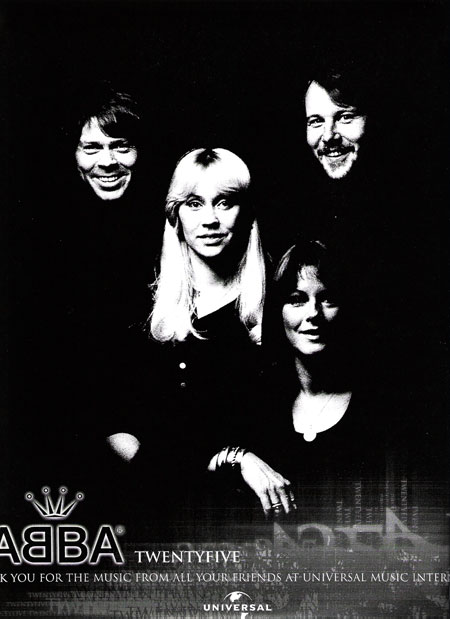
Jorgen Larsen, chairman and CEO of Universal Music International, is now, by a twist of fate, united with the band that he helped launch on its way to global stardom. As managing director of CBS Sweden from 1972 to 1978, he was asked permission in early 1974 for one of the company’s solo artists, Agnetha Fältskog, to join the fledgling ABBA. “We reached some token financial arrangement,” recalls the ever-understated Larsen.
But his involvement went beyond that. As a favor, Larsen also participated in placing the single Waterloo in major markets and asked colleagues at the CBS U.K. company to consider it.
“Two months later, the band won the Eurovision Song Contest,” recalls Larsen. “Everyone can remember where they were when that happened, like they can remember where they were when JFK was shot. I was at a hotel in Gloucestershire, taking some time off.”
Larsen’s participation led to a long-term relationship with the British label. “The band was with CBS in the U.K. since then and, of course, they sold millions of records,” he says, “and their involvement remained until the deal with PolyGram.”
Following PolyGram’s 1998 merger with Universal, the ABBA catalog has become one of the jewels in the crown of the new company’s back repertoire.
“It’s such a household name, it’s like a brand in its own right,” says Larsen. “It’s a fine body of work. We can mix and match [it in] almost any combination, and one is almost assured an incredible success.”
– From Dominic Pride.
In the history of ABBA, the name of the late Stig Anderson is unavoidable. The band’s manager, publisher, co-writer and mentor, he is credited with being the behind-the-scenes force that drove ABBA’s global success.
Stig or “Stikkan” Anderson, as he was known, formed publishing company Sweden Music and Polar Records, which, between them, looked after rights to much of the ABBA catalog. Anderson sold the two companies to PolyGram in 1990. When he died in September 1997, he was still working with PolyGram, remastering ABBA’s catalog.
In 1994, he gave an interview to Billboard in which he said he believed the band’s visual image and its distribution was central to ABBA’s global success. “The base is the song. It has always been,” said Anderson. “The talent must be there. Then there’s the hard work to market it. The marketing has changed through the years, but the image is now just as essential as the record to get the 20-plus audience.
“I was really the first one to think of this. Back in 1974, when we had Waterloo and we won the [Eurovision] Song Contest, I started to film. In those days, we had 16 mm film, and we sent it all over the world.”
The idea was a novelty, recalled Anderson: People asked me what I was doing. I said, “I’m sending film to people so they can see the act in Chile, Japan or Australia. Our people in Japan could take it to the TV station and show it.” It was this innovation that contributed to global success, Anderson maintained. “That was how it started in a big way with ABBA in Australia. All of a sudden, when you could actually see the act, we were No.1. That’s why we had a film for every single since the beginning. We couldn’t travel to all these countries, so we sent a film to 60 different countries, and it was shown everywhere. This was very important for ABBA.”
– From D. P.
We’re happy to announce that we were wrong. We were 11 million albums wrong. When [Polydor U.K special projects manager] Chris Griffin and I were putting together ABBA Gold, we tried to estimate how much we were going to sell. First, we said 1 million, but we stretched it to 2 million – which we believed was a very high estimate. It’s now reached 13 million copies sold, a very delicate mistake! It still moves 1 to 2 million copies a year, so it’s not over yet.”
– From Ingemar Bergman, managing director, Sweden Music.
Viewed in a historical perspective, ABBA is one of the 10 greatest pop bands in the entire world. Every week, we’re still getting requests from all over the world from concert promoters who ask about reunion concerts. We went to Waterloo the day after their [Eurovision Song Contest] victory, after an invitation from the mayor there. Waterloo’s a small town, and, when we came, the streets were filled with people. I though, ‘This has to end up in a catastrophe.’ It ended up in total chaos, and we had to take the car and drive from there. It was a very short visit to Waterloo.”
– From Thomas Johansson, founder and managing director of EMA Telstar, which promoted ABBA’s worldwide tours.
I first heard about ABBA in late 1972 at CBS Records, when they were known as Björn, Benny, Agnetha & Anni-Frid and I was manager of international A&R for CBS.
“Stig Anderson, their manager, had known me because of my former band, The Zombies, for whom he was Scandinavian sub-publisher. He sent me a tape of them singing Ring, Ring in Swedish, which I loved. I played it for Dick Asher, then MD of CBS Records U.K., who thought I was nuts to want to sign a Swedish band, until I told him they could sing in six languages!
“So, I signed them (my very first signing!) to a singles deal for a £500 advance against 10% royalty, and released Ring, Ring. It barely scraped the bottom of the chart. I was distraught.
“Then, a few months later, an excited Stig arrived with a new tape of Sweden’s entry to the Eurovision Song Contest: Waterloo by the newly named ABBA. All of us at CBS were knocked out and fully expected it to be a smash, whether or not it won. Of course, the rest is history.
“But then, in a very sweet gesture, Björn asked me to go to Stockholm to remix Ring, Ring with him and Benny and spend the weekend with them, Agnetha and Anni-Frid on their private island. It was idyllic, especially being woken up and served breakfast in bed by Anni-Frid!
“Congratulations and best wishes to ABBA and the late Stig for their greatly deserved, success!”
From Paul Atkinson, VP, catalog A&R, Capitol Records
ABBA’s records remain masterpieces. Even after all these years, they’re as fresh as ever. Their songwriting and productions are in a class by themselves. I have had the pleasure of meting ABBA several times, and I will always cherish the memories.”
– From Neil Sedaka.
“ABBA’s contribution to popular music is more than just a catalog of outstanding songs and performances on record. They were the first in the rock-music era to show that a worldwide impact upon contemporary music does not have to originate from the United States or Great Britain. Their great hit songs sound even better now than they did when they were first popular; the theatrical works that Björn and Benny have subsequently produced have more than matched up to the phenomenal standards they established in their ABBA days .”
– From Tim Rice.
ABBA: Thank You For The Music; Görel: Thank you for your generosity; Stig: Thank you for everything. Rest in peace.
– From Brian.
From the very first concert in Lulsa to the latest in Tokyo, where will the next one be? See you soon Thomas. (In between we have done Chess In Concert, albums with Frida and Agnetha, performing right now at the Circus Kristina Från Duvemåla and we wish much success to Benny and Björn for Mamma Mia! opening in London on 6th April, 1999)
– From Thomas Johansson - EMA Telstar: Tour Promoter.
Thank You For The Music: Congratulations on a quarter-century of musical excellence ABBA.
– From The Universal Music Group U.S.
ABBA Twenty-Five: Thank you for the music
– From all your friends at Universal Music International. Transcribed for ABBA World
|
|
|
BACK | HOME | MAIL | Disclaimer |
|
This site uses frames. If you came directly to this page from an external link, welcome to ABBA Omnibus. Please click here to go to the home page. |
 |