|
|
The four members of ABBA were already well-known individually in Sweden before they came together as a group. Agnetha Fältskog and Anni-Frid Lyngstad had successful solo careers, while Björn Ulvaeus was in a popular folk group called The Hootenanny Singers and Benny Andersson was in a pop group known as The Hep Stars. One fateful day, the tour buses for The Hootenanny Singers and The Hep Stars were traveling down the same road and the groups stopped to meet each other for the first time. They got together that night for a party after their respective gigs, marking the first time that Ulvaeus and Andersson sat down and talked with each other. Before their groups broke up, Ulvaeus and Andersson became romantically involved with Fältskog and Lyngstad, respectively.
The foursome formed a cabaret act that was fairly disastrous, but Benny and Björn wrote a pop song called Hej Gamla Man, which was the lone highlight of the act. They decided to focus on being a pop group, which soon took the name ABBA, with each member loaning their first initial to the group’s name.
With influences as diverse as The Beach Boys, Phil Spector, The Kingston Trio and skiffle music, ABBA captivated audiences with tightly produced pop arias sporting beautiful harmonies. It might not have been “cool” or “hip” to admit to liking ABBA in an age when album-oriented rock artists ruled, but time has provided vindication to ABBA-lovers who, with the release of Erasure’s ABBA-esque EP in 1992, were finally given permission to come out of the closet about their deep and unyielding devotion to the Swedish quartet.
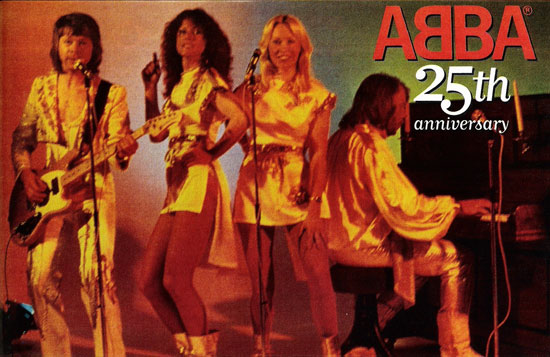
Twenty-five years after their breakthrough with Waterloo, a greatest–hits collection titled ABBA-Gold continues to sell 1 million copies per year and has reached the amazing figure of 13 million albums sold worldwide.
We met with Björn Ulvaeus in the cozy library of a West End hotel in London to discuss ABBA’s silver anniversary. Ulvaeus had just come from a rehearsal of Mamma Mia!, a musical based on the songs of Ulvaeus, Andersson and Stig Anderson. The show will open at the Prince Edward Theatre on April 6th, 1999 – the 25th anniversary, to the day, of the group’s career-launching victory with Waterloo at the Eurovision Song Contest. Transcribed for ABBA World
|
BACK | HOME | MAIL | Disclaimer |
|
This site uses frames. If you came directly to this page from an external link, welcome to ABBA Omnibus. Please click here to go to the home page. |
 |