Little did Marcel Baison of France know what he was starting. Inspired by the success of Italy’s San Remo song festival, Baison came up with the idea for a song competition that would bring the nations of Europe closer together in the first decade after World War II.
Produced by the then-new European Broadcasting Union, the first Eurovision Song Contest had only seven countries competing when it took place May 24th, 1956, in Lugano, Switzerland. More than 40 years later, the annual contest draws a television audience of 300 million viewers from all over Europe, and more than 30 countries, including many from Eastern Europe, are eligible to compete.
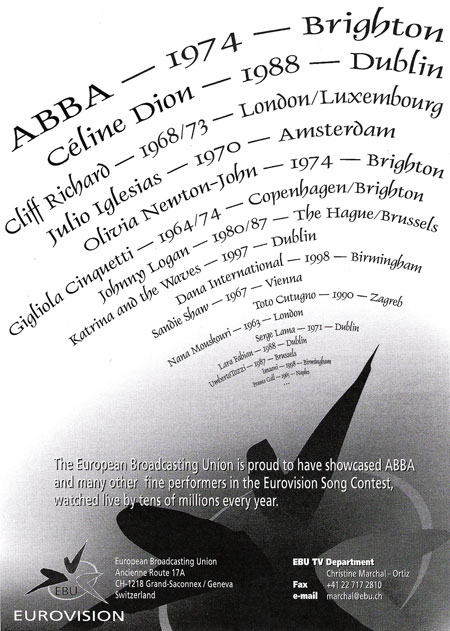
In its four-decade history, Eurovision has yielded a number of worldwide hits. The most successful group to ever come out of the contest is ABBA, who parlayed its 1974 win with Waterloo into global success.
First Volare, then Waterloo
“At that time, it was the one and only vehicle to reach outside Sweden,” explains Björn Ulvaeus. “Because there was no way anyone in England or America would listen to anything coming from this obscure country. You could send them your tapes, knowing they threw them away immediately. So the only chance was to enter Eurovision with a song, and that had such an impact in Europe at that time.”
Other well-known names have also competed. Celine Dion, Julio Iglesias, Nana Mouskouri, Olivia Newton-John and Cliff Richard have all been Eurovision contestants. Of those five, only Dion has won the competition. She was a 19-year-old unknown when her 1988 entry for Switzerland, Ne Partez Pas Sans Moi, beat the U.K. entry by one point in a cliffhanging vote.
A song doesn’t have to win the Eurovision Song Contest to be an international hit. In 1958, Italy’s Domenico Modungo placed third with Nel Blu Dipinto Di Blu, which came to be known as Volare. Nine years later; Vicki Leandros represented Luxemburg with L’Amour Est Bleu. It placed fourth, but was more successful when recorded as an instrumental by Paul Mauriat under the title Love Is Bleu. It placed fourth, but was more successful when recorded as an instrumental by Paul Mauriat under the title Love Is Blue. And, in 1996, Australian singer Gina G went to bat for the U.K. with Ooh Aah…Just A Little Bit. The juries voted it eighth, but the public had its own say. The single topped the British chart and became the most successful British entry in Hot 100 history, peaking at No.12 in the U.S.
Transsexual vamp
The modernization of Eurovision can be traced to the U.K.’s 1995 entry, suggests Tip Sheet publisher Jonathan King, who overseas the Great British Song Contest as the music executive for the BBC. Britain sent a melodic rap song by Love City Groove in 1995. Since then, there has been a boy band from Hungary, a rapper from Denmark, a neomodern dance act from Iceland and a transsexual singer from Israel who has become an icon in the international gay community.
Eurovision has become more contemporary in other ways, too. The system of small juries in each country deciding the outcome has gone by the wayside; the winner is determined by televoting, with people all over Europe having five minutes to cast their vote by televoting, with people all over Europe having five minutes to cast their vote by telephone. And the 1999 contest will be the first in 25 years to have a “free language” rule, where countries can enter songs in any language they wish. It will be the first time since ABBA won by singing Waterloo in English that entrants can opt for this choice.
The 1999 contest will be held in Jerusalem on May 29th, following the tradition where the winning country becomes host the following year. This year promises to be another contemporary competition, with a teen trio from Malta, a boy band from Israel and a 17-year-old female singer from Austria among those looking for an entry to the world stage. Transcribed for ABBA World
|
|
|
BACK | HOME | MAIL | Disclaimer |
|
This site uses frames. If you came directly to this page from an external link, welcome to ABBA Omnibus. Please click here to go to the home page. |
 |