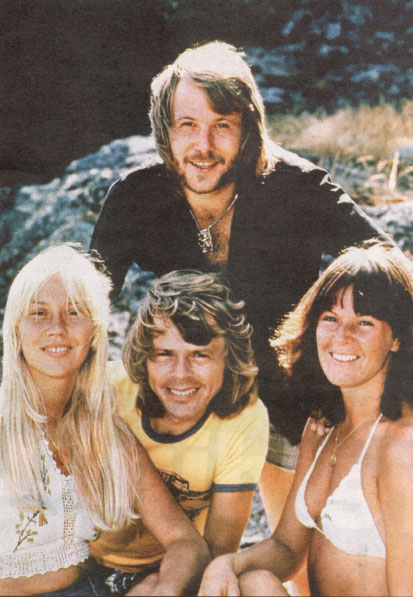
 Music historians, commentators and fans have ruminated for decades about the
mythical and magical relationship that exists between ABBA and
Music historians, commentators and fans have ruminated for decades about the
mythical and magical relationship that exists between ABBA and
Music historians, commentators and fans have ruminated for decades about the
mythical and magical relationship that exists between ABBA and
At every significant anniversary, or as they help launch some new entertainment event that will inevitably reignite ABBAmania, the two Bs are asked to explain why they continue to strike a chord with Australians. On the publicity trail to launch the movie version of blockbuster stage show Mamma Mia!, Ulvaeus speculates that it may be a cultural connection born of the tyranny of distance, and the seeing of similarities in each other.
“There have been many theories on why
Andersson, however, proffers a much cheekier hypothesis: “And we look like wombats.” Truth be told, it was all Molly Meldrum’s fault.
Then hosting Countdown, one of the most influential music television programs in the world, Meldrum was desperate for international product to air on the show.
Because of ABBA’s reluctance to venture far from their Swedish home, the band
employed director Lasse Hallström to make promotional films to advance the group
after their Eurovision Song Contest win with
Hallström directed videos for Mamma Mia, I Do, I Do, I Do, I Do, I Do, Ring, Ring, Waterloo and SOS, putting Björn, Benny, Frida and Agnetha front and centre, which was contrary to the aesthetic of early music clips. Meldrum got the can of films in 1975 … and the music producer in him knew these were potential pop hits.
While the band’s label RCA had no plans to release Mamma Mia as a single, Meldrum trusted his gut instinct and with the considerable power Countdown was beginning to demonstrate here to create hits, insisted it be given an airing.
“They [the various record companies] were not communicating. They would do
with us, to our office in
“Then all of a sudden there was a No.1 in
The hits just kept coming, with ABBA dominating the Australian charts in late 1975 with three consecutive No.1s in I Do, I Do, I Do, I Do, I Do, Mamma Mia and SOS.
The pop phenomenon kept rolling on through 1976 with Fernando and Dancing Queen. In the process, Meldrum learned the hard way not to mess with ABBAmania.
After Fernando’s 11th week at No.1, the Countdown producers baulked at airing the fireside clip again to close the show and broadcast a hit prediction instead.
“The ABC switchboard was bombarded with complaints,” Meldrum recalled in
2002, as the Mamma Mia! stage musical
began its
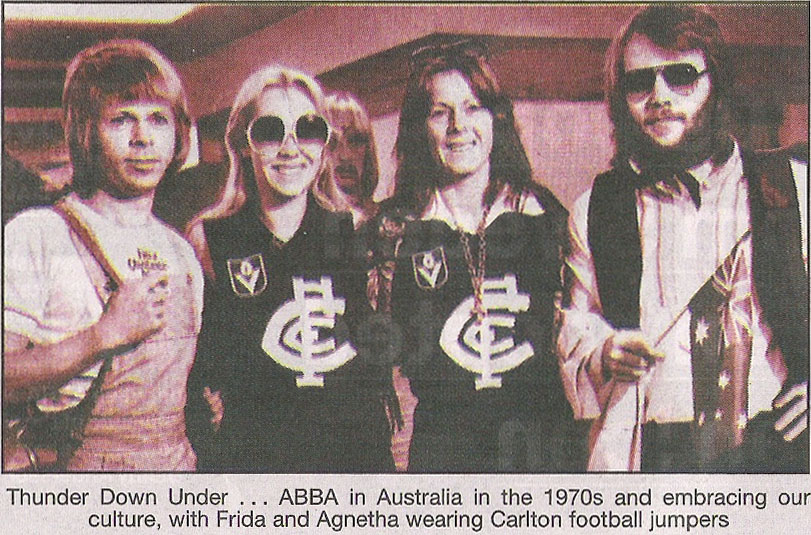
The frenzy became hysteria when this fab four arrived in
The band was reportedly paid $100,000 for the show, with Nine outbidding
rival stations in
The television special attracted a record audience, reportedly drawing half
the Australian population to watch, and even out-rating the 1969 moon landing.
When ABBA returned to tour in 1977, the reaction Down Under
rivalled that of Beatlemania. Their Sebel Town House press conference in
Potts Point drew 300 journalists and photographers, 140,000 fans bought tickets
to their shows in
Prime Minister Malcolm Fraser and his family were among the legions, meeting
Benny, Björn, Agnetha and Frida backstage after their
More than anywhere else outside of
But Andrews says the band were equally gutted when their popularity waned here almost as soon as they left after the 1977 tour, during which they also filmed ABBA-The Movie. He blames the backlash on the avalanche of merchandise released by Reg Grundy Productions which owned the exclusive licence to official ABBA products, from tea towels to pillow slips, in the 1970s.
“[ABBA] were very upset that it petered out,” Andrews says. “I think it was a huge case of over-exposure. Reg Grundy Productions pumped out so much products, so much stuffs, you were just overwhelmed by it all.
“It became totally, totally daggy to like ABBA. They had become the ultimate dag band and you were really going out on a limb if you dared say you were a fan after 1977.
“As soon as they left
“And then ABBA-The Movie flopped
here as well. I think it was a mirror being held up to us, how crazy we were
about them and then we were over it. The paradox was that it was
The ABBA controllers put the Australian directors who wanted to use Mamma Mia, Fernando, Dancing Queen and other ABBA classics in their films through an Olympic course of hoops. As Andrews explains: “Once again, it was the Australians who came to the ABBA party with Priscilla and Muriel’s Wedding, two films that resuscitated [the band’s] career. Stephan Elliot, the director of Priscilla, told me that ABBA sent this huge plaque to him with gold records a year or two later to thank him.
“They knew that the success of those films had helped kick-start ABBAmania again.”
Universal Music
There are no new products from the band’s vaults in
There’s a simple hypothesis, says Rod Cameron, the commercial director of
Universal Music
“I don’t think there’s anything left in the vaults,” he says about the lack of unreleased material.
“[But] it’s almost impossible to answer the question why ABBA keeps selling so much product every year. We would have to be close to being the biggest market per capita in the world for ABBA products. There are maybe a handful of artists and albums, depending on your age, that are in everybody’s collection. Hot August Night [Neil Diamond] would be up there. If you’re between 50 and the grave, Brothers In Arms [Dire Straits] and Frampton Comes Alive [Peter Frampton] would be in there.
“But in between all of those albums is an ABBA record.”
Andersson and Ulvaeus rule the rights to their music with iron fists.
Cameron believes they have governed the band’s legacy partly by maintaining their mystique and mostly by guarding the integrity of their hits.
“When artists are ubiquitous, the public reaches a point where subconsciously they go, ‘Enough!’. There is an ABBA’s music story, whether it’s the stage show or the film, that surfaces every once in a while to keep the embers burning.
“The fact that Benny and Björn have exercised such control over the exploitation of the catalogue and care over the packaging of it has kept the integrity of the songs.
“It could be argued that if music industry executives like me were given free reign over that legacy, we may have .….. it up.
“As far as I am aware, they have never allowed their songs to be synchronised to advertise products, whether it was ice cream or Viagra. I know a massive amount of work went on before they agreed to let their songs be used in Muriel’s Wedding and Priscilla.
“And Benny and Björn also have the right to refuse the shows to be covered … and it is a right they exercise frequently.”
Perhaps another of the contributing factors to maintaining our love affair with ABBA is that they have never sold out for the reunion buck.
It is urban legend that they were offered $1 billion to reunite for concerts – some say it was a Russian oligarch who wanted to engage their services for his daughter’s wedding; others point the finger at an American-British consortium that wanted to stage 100 ABBA concerts worldwide. Their lifelong fans, and those who have stayed the distance since they broke up in the end of 1982, all agree: they do want a reunion as much as the band members don’t want one.
“The one thing I am absolutely sure of – with all due respect to those heritage artists out there recording their comeback albums right now – is that the creative period during which they poured forth their best work can never be recaptured,” Cameron says.
So fans content themselves with those compilations, the upcoming vinyl re-releases of their albums and Mamma Mia! the musical and the film. Or the latest tour by Björn Again and BABBA, both Australian tribute acts.
The stars of the film – an ensemble cast led by Meryl Streep, Pierce Brosnan, Colin Firth and Julie Walters – had no reservations about putting their “serious actor” reputations on the line to ham it up in the film.
Why? Because it’s all about the songs. While Ulvaeus, Andersson and the commentators still wax lyrical trying to work out why these four Swedes remain one of the most successful acts of all time, there’s a simple truth in that. Streep has her own theory on the band’s success.
“I asked Benny, ‘What is it that you and Björn do that gets a hook in people’s hearts and even if you try you can’t get this song out of your head?,” the actress mused at this week’s Athens premiere.
“It’s a specific kind of gift that they have. Some people have it. There’s a lot of No.1 records that you’ve forgotten by next year. Theirs survived for 30 years … The Beatles survived.
“Who knows why, but I think part of the ongoing appeal across cultures, many different kinds of people, many different ages, is that there’s something essentially good-natured about it.” Transcribed for ABBA World
 |
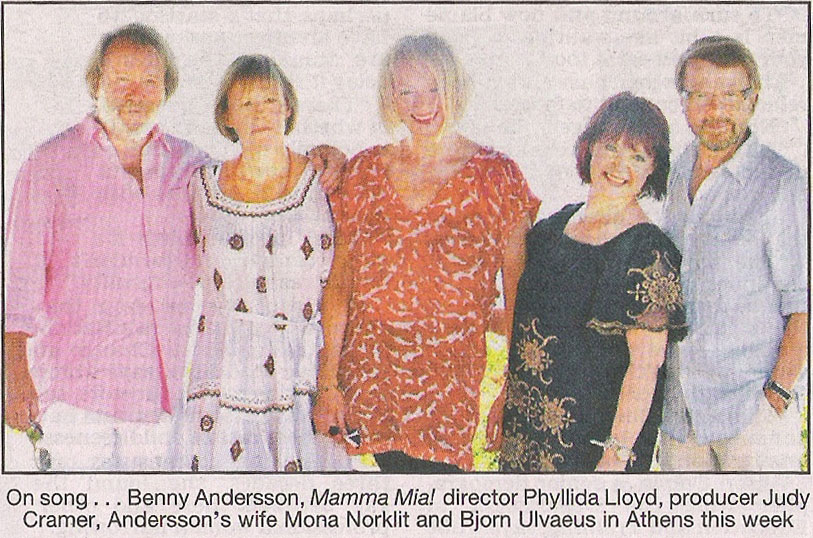 |
Photos: (1) Thunder Down under …
ABBA in
|
BACK | HOME | MAIL | Disclaimer |
|
This site uses frames. If you came directly to this page from an external link, welcome to ABBA Omnibus. Please click here to go to the home page. |
 |